
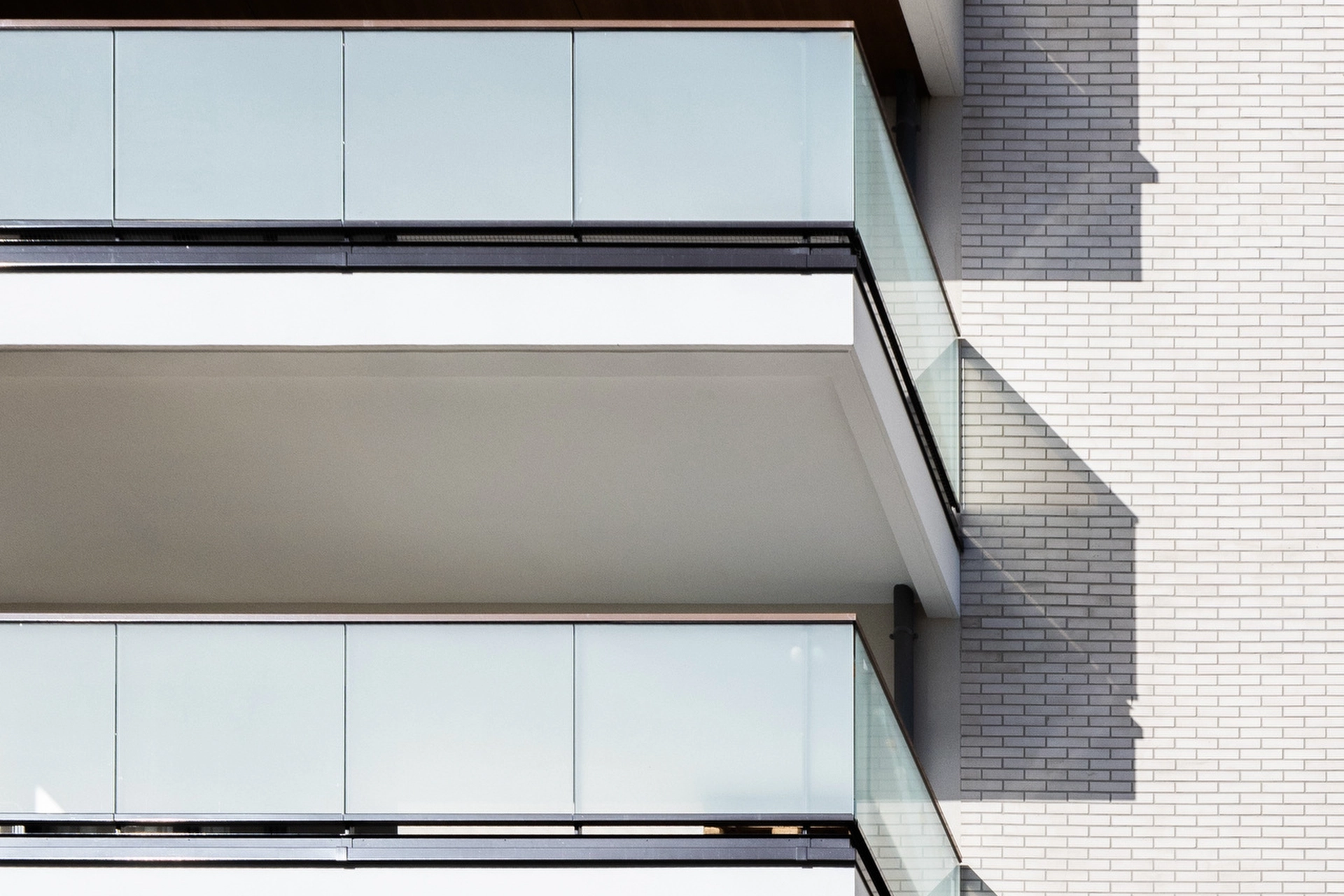
In traditional photography, we are often taught to flee the midday sun, deemed too harsh and overly contrasted. Yet, in architecture photography, this zenithal light can become a powerful ally.
As Le Corbusier said: “Architecture is the learned, correct, and magnificent play of volumes assembled under the light.” A shadow is not an absence of light; it is a fully-fledged shape that draws on the facade, revealing the structure and creating a unique graphic aesthetic.
An Ephemeral “Second Architecture”
The cast shadow of a balcony, a railing, or a neighboring tree creates a pattern on the wall that changes every hour of the day. It is a moving architecture that superimposes itself on the building.
My job as a photographer is to anticipate the precise moment when the shadow aligns perfectly with the structure to create a pure geometric composition. This is where the importance of scouting takes on its full meaning: you have to know exactly when the sun will transform an ordinary facade into an abstract painting.
Revealing Rhythm and Texture
This graphic style excels particularly on contemporary buildings equipped with sunshades, claustras, or metal cladding. Hard light creates a binary visual rhythm (Shadow / Light / Shadow / Light) that accentuates repetition and depth.
This is an ideal approach to sublime minimalist architecture, where the simplicity of shapes requires radical lighting so as not to appear flat. Low-angle shadows reveal the grain of the concrete or the texture of the wood with surgical precision.
The Technical Challenge: Mastering Dynamics
Photographing in direct sunlight is a perilous exercise. The risk is “blowing out” the whites or crushing the blacks. Everything depends on the orientation of the building and the shooting angle. My technique consists of exposing for the highlights to retain texture and detail in the bright walls, while accepting the deep, dense shadows that structure the image.
Saturated Color: A Strong Visual Signature
Unlike certain approaches that favor Black & White for graphics, I choose color to anchor the building in its environment. Under harsh light, colors are not washed out; they vibrate. The blue of the sky becomes deep (thanks to a polarizer) and the facade materials (brick, wood, colored plaster) gain in saturation.
My approach consists of playing on this strong chromatic contrast: the opposition between the lit area (bright) and the shadow area (dense and cold) creates an image with relief, almost tactile. It is a subtle balancing act that I also discuss in my article on color management.
Conclusion
Do not fear the midday sun. With the right eye and the right technique, it is the moment when your building most strongly asserts its character. Cast shadows do not hide the architecture; they sculpt it.
Do you have a project with bold lines? Let’s discuss how to bring it to light.