
In residential architecture and the hospitality industry, the bathroom occupies a paradoxical place. It is often one of the smallest rooms in terms of floor space, but it is also the most expensive per square meter, concentrating noble materials (marble, ceramics, high-end fixtures) and complex technical installations.
For a professional photographer, it is a true geometric puzzle. Between the cramped space, the omnipresence of mirrors, and the glossiness of surfaces, there is no margin for error. A failed photo will give the impression of a dark, clinical closet, whereas a successful photo must instantly evoke the well-being, luxury, and relaxation of a private spa.
The Challenge of the Invisible: Managing Mirrors and Reflections
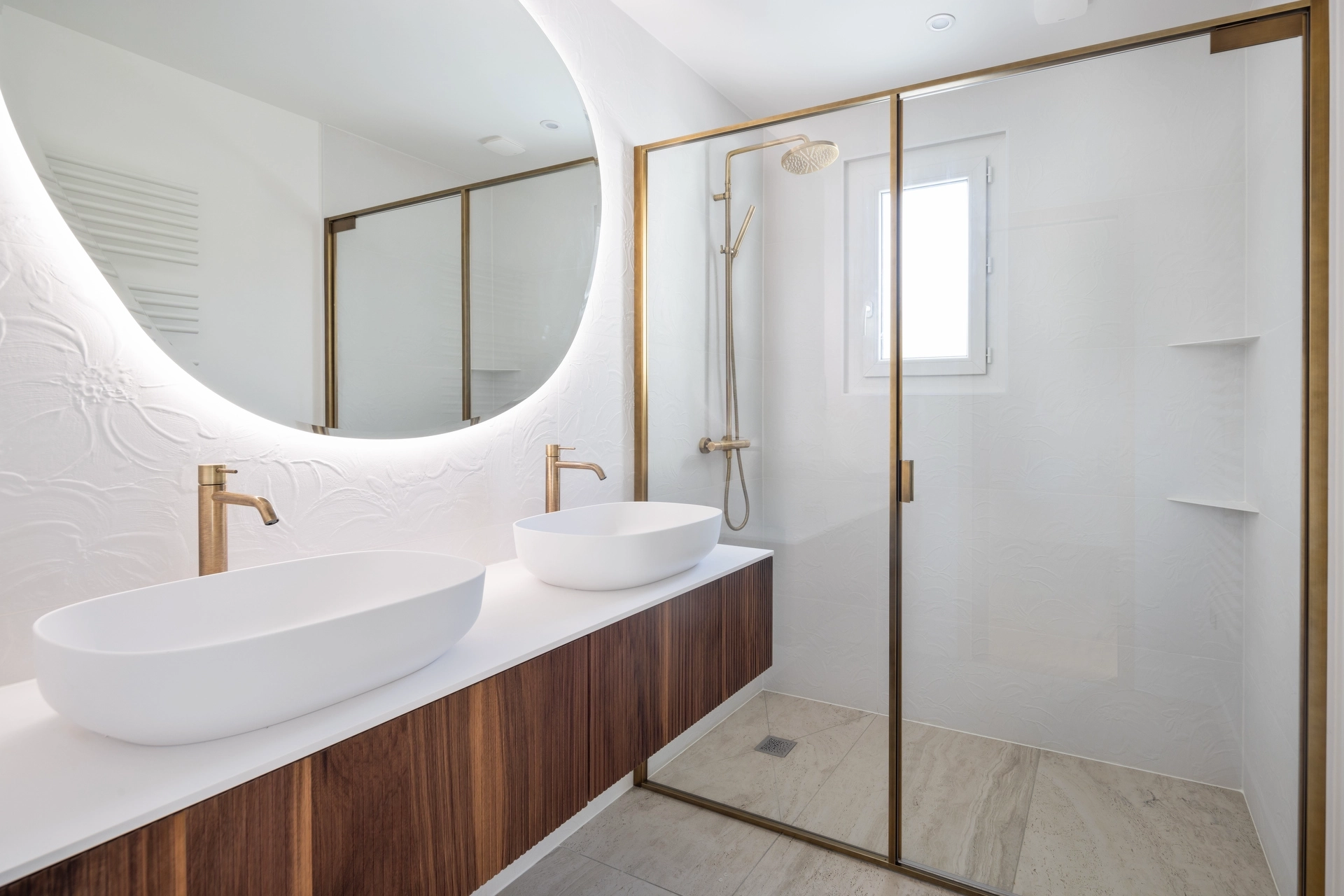
The number one constraint in a bathroom is obvious: mirrors. They are everywhere—above the sinks or on closet doors. The challenge for the photographer is to become invisible. It is unthinkable to see the reflection of the tripod, the camera, or the photographer themselves in the final image.
To bypass this trap, I use specific shooting techniques. Positioning comes down to the millimeter to find the blind spots. Using tilt-shift lenses sometimes allows me to photograph a mirror straight-on while “shifting” the optics so as not to appear in it. If the layout leaves no escape, the magic happens in post-production: I digitally clean the image to remove parasitic reflections while preserving the natural luminosity of the glass.
Pushing Back the Walls: The Art of Wide-Angle in Closed Spaces
How do you show all the amenities (bathtub, walk-in shower, double vanity) without having enough room to step back? The temptation is great to use an ultra-wide angle to shoehorn everything in. This is a common mistake that distorts reality: the bathtub stretches unnaturally, and the room seems huge but empty.
As I mention in my article on the wide-angle myth, my approach favors realism. I look for vanishing lines that guide the eye and give a sense of depth without caricatural distortion. The landscape format is crucial here to visually “widen” the walls and let the composition breathe.
Enhancing Materials: From Marble to Ceramics
The bathroom is a universe of “cold” and reflective textures: glossy tiles, glass shower enclosures, chrome faucets, polished stone. Light management is crucial so as not to end up with an aggressive image dotted with unsightly light bursts (“hot spots”).
I often work with natural light or highly diffused lighting to model the volumes. The goal is to bring out the veining of a marble slab, the grainy texture of natural stone, or the sleek design of the fixtures, avoiding hard reflections that impair the reading of the materials.
“Staging”: The Detail That Changes Everything
Finally, an empty bathroom can seem sterile. Conversely, a bathroom left “as is” (with toothbrushes, disparate cosmetic products, and bathrobes) lacks elegance. The success of the photo also relies on “Home Staging” or styling.
Before shooting, I declutter the space. We keep only the essentials: a stack of perfectly folded white towels, an aesthetic perfume bottle, or a green plant to bring an organic touch. It is this visual silence that allows the future buyer or guest to project themselves into a moment of relaxation.
Conclusion
Bathroom photography is a precision discipline. It requires juggling the laws of optical physics to transform a constrained technical space into a place of dreams and serenity.
Do you have a renovation project or a luxury property to showcase? Discover my interior real estate portfolios.