
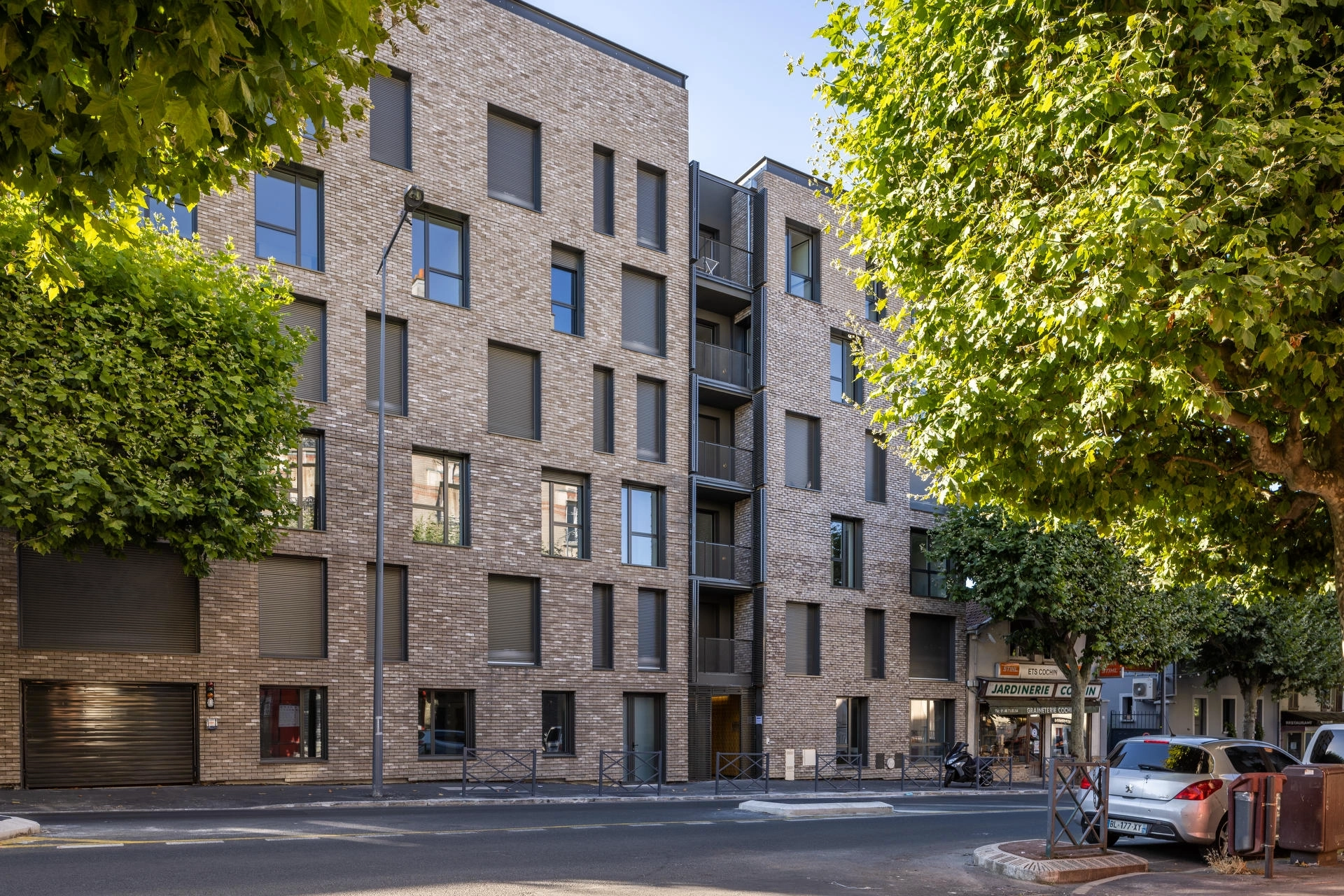
In architecture photography, distortions and converging verticals are a constant challenge. As soon as I photograph a building from the ground or a narrow interior space, lines naturally distort.
The tilt-shift lens allows me to correct these flaws right at the moment of capture, without relying on heavy post-production corrections. It is an essential tool for producing precise, elegant, and credible images. To discover my overall approach to architecture photography, you can browse my dedicated portfolio.
Straightening Verticals: The Foundation of a Reliable Architectural Image
Thanks to the “shift” function, I correct verticals without tilting the camera. Instead of pointing the camera body upwards, I keep the axis perfectly straight and adjust only the lens optics.
The result:
- A tall facade regains its natural geometry.
- Absolutely no distortion.
- No loss of image quality.
- A rendering that is immediately usable for architectural portfolios or high-end communication.
To understand how I organize my series to guarantee perfect consistency, my article on organizing an architecture shoot details my methodology.
Preserving the Building’s Geometry
In architecture, geometry is never just a detail: it is the core of the project. With a tilt-shift lens, I respect:
- The drawn lines.
- The actual volumes.
- The structural axes.
- The exact proportions.
Photography becomes a faithful translation of the architectural intent, which reinforces the understanding of the project and the credibility of the series.
Building a Coherent Series
An isolated image must be flawless, but a series must be even more homogeneous. When all the photos feature accurate verticals and a consistent rendering, the entire set gains elegance.
This is a decisive point for:
- An architect’s portfolio.
- A commercial brochure.
- A call-for-tender folder.
- A showcase website.
This topic also ties directly into my article on anticipating and correcting optical distortions.
Tilt-Shift in Interior Spaces
Indoors, the tilt-shift lens radically changes the way a room is photographed. It prevents typical distortions: slanted walls, stretched furniture, rounded countertops, and severe converging perspectives in small spaces.
The image remains faithful to the interior designer’s work and the structure of the room. To discover how I choose the most relevant spaces to photograph in a property, you can read my article dedicated to the essential spaces to photograph in a home.
My On-Site Method
When I use a tilt-shift lens, I rely on a precise approach:
- Anticipating the angle choice based on the necessary shift.
- Millimeter-precise adjustments for perfect geometry.
- Using a sturdy tripod and an electronic level.
- Strict control of verticality and proportions.
- Consistency of light and materials throughout the entire series.
This methodology allows me to achieve a natural, mastered rendering that is immediately usable for my clients.
The Benefits for My Clients
Using a tilt-shift lens brings concrete advantages:
- A more professional and high-end result.
- A clear reading of volumes.
- Accurate and coherent perspectives.
- A better understanding of the project.
- Precise enhancement of the architectural design.
To discover how I use light to further reinforce this precision, you can consult my article on mastering natural light in contemporary architecture.
Conclusion
The tilt-shift lens is not simply a technical tool: it is a centerpiece of my work. It allows me to produce accurate, elegant, and perfectly mastered series. By integrating it into every architectural project, I guarantee a professional, coherent result that is completely faithful to the intent of the architects, developers, and decorators who place their trust in me.