
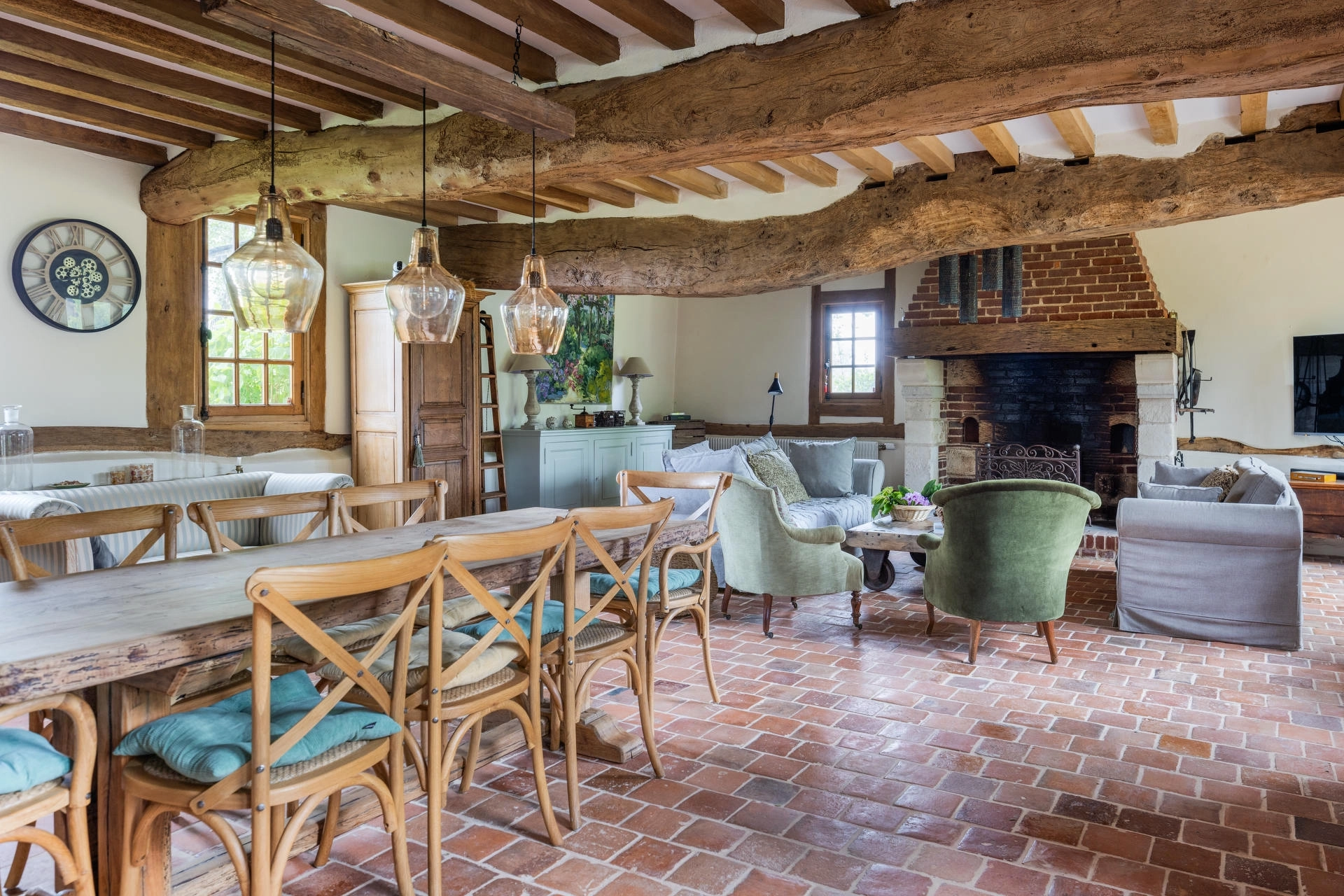
It is a scene that repeats itself at the start of every shoot. As I set up my tripod, the owner or real estate agent rushes to the light switches: “Wait, I’ll turn everything on, it will look prettier!”
My answer is invariably the same: “No, please, leave everything off.”
This approach can be surprising. For a long time, “standard” real estate photography dictated that all chandeliers and sconces had to be turned on to create a “warm” atmosphere. Yet, in a modern, high-end architectural approach, this is nonsense. Who needs to turn on the light in a sun-drenched room? Turning on artificial lighting in broad daylight doesn’t add light; on the contrary, it “darkens” the perception of the space and alters the purity of the location. Here is why.
The Color War: Orange vs. Blue
The first problem is purely physical: it’s the conflict of color temperatures. Daylight (which enters through your windows) is bluish and white. Your indoor bulbs (Tungsten or warm LEDs) emit an orange or yellow light.
If you mix the two, the camera sensor gets confused. The result is a “chromatic mush”: the walls near the windows are blue, those near the lamps are straw-yellow. In post-production, it becomes very difficult to recover the “true” white of your walls. By turning off the lights, we unify the light source. The result? Faithful colors, pure whites, and a clean image worthy of an interior design magazine.
The Brightness Paradox: Why Turning On “Darkens”
This is the most counter-intuitive argument, but the most important: turning on a lamp in broad daylight reduces the room’s feeling of brightness.
A lightbulb, even a powerful one, will never rival the intensity of the sun. By turning it on, we create a very bright little hot spot that catches the eye. By contrast, the rest of the room (lit by natural light) suddenly seems duller. In addition, chandeliers often create unsightly cast shadows under furniture, visually weighing down the space.
By working with the lights off, and perfectly managing the backlighting, I let the natural light softly envelop the volumes, without conflict or artificial shadow zones.
The Psychological Argument: “Is It Dark in Here?”
Beyond technique, there is the subliminal message sent to the buyer or visitor. Imagine a living room photo taken at 2:00 PM, where all the lamps, spots, and sconces are turned on. What does the brain of the person looking at the photo subconsciously think? “If they need to turn on the light in the middle of the afternoon, the apartment must be dark.”
Conversely, a photo taken with the lights off is a proof of confidence. It demonstrates that the property is naturally bright, well-oriented, and needs no artifice to be habitable. It is a guarantee of quality and well-being.
An Architectural Aesthetic
Look at publications in major architecture magazines (AD, Elle Décor). You will see that 90% of daytime photos are taken with the lights off. This aesthetic, combined with a mastered shooting height, gives the image a calm, poised, and timeless appearance. Artificial lighting is often synonymous with “commercial” staging, whereas natural light evokes design and architecture.
The Exceptions
Of course, there is no absolute dogma. In very rare cases, I agree to turn on a light:
- A windowless room (windowless bathroom, walk-in closet).
- Specific architectural lighting (an LED-lit niche, a marked staircase) that is part of the structural design.
- A bedside lamp to add a “cozy” touch in a dark corner, but set to a very low intensity.
Conclusion
Luxury is space and natural light. My job as a photographer is to capture this solar light, model it, and sublime it. Leaving the switches on “OFF” is choosing clarity, truth, and elegance.
Want to see the difference natural light brings to a reportage? Browse my portfolio.