
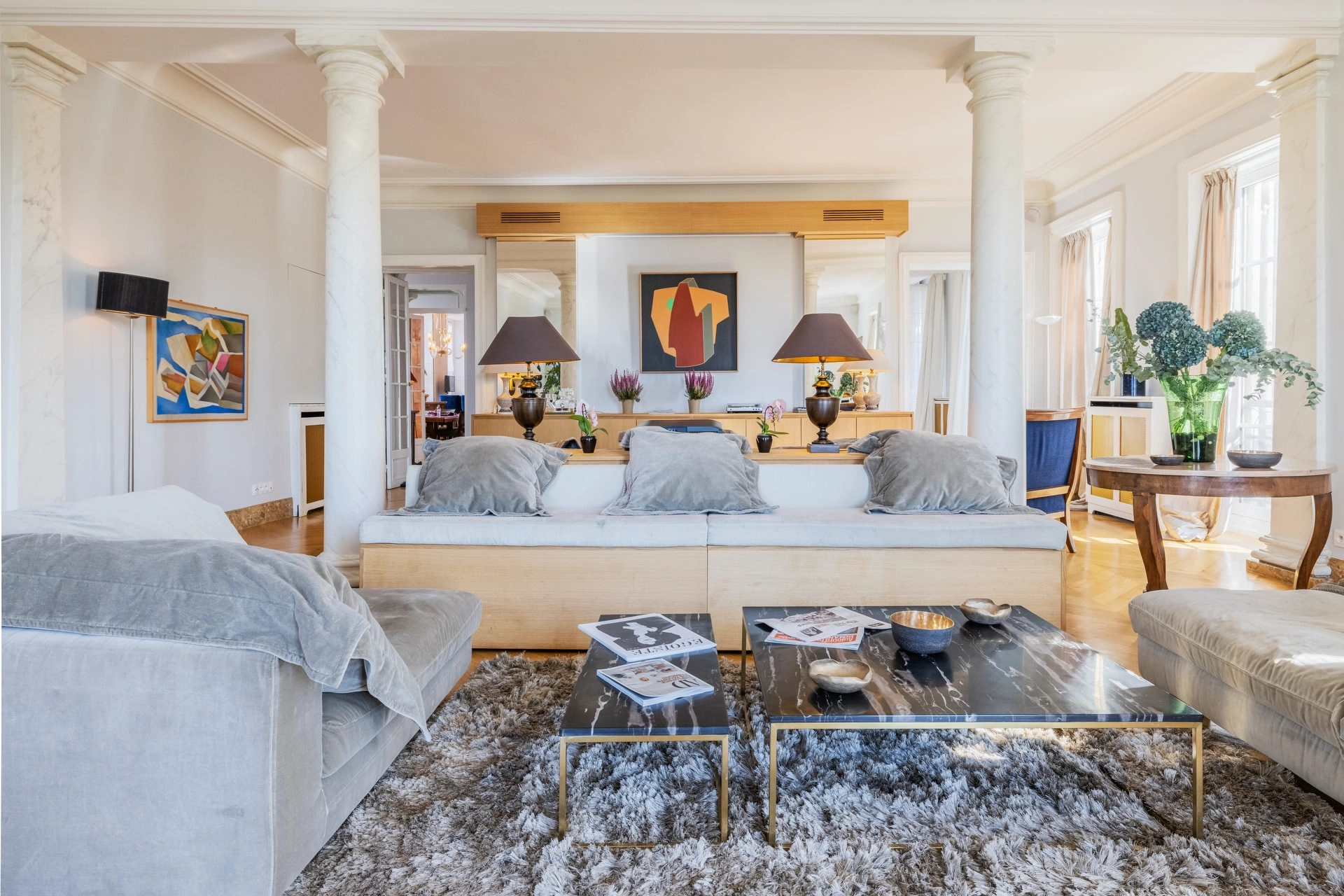
The Parisian Myth Put to the Test of the Lens
Paris would not be Paris without Baron Haussmann. From the Étoile to République, passing through the wide avenues of the Hauts-de-Seine (Neuilly, Boulogne), this architectural style defines French elegance. For a real estate agent or an interior designer, a Haussmann-style apartment is a safe bet, but it is also a complex visual challenge.
Why? Because Haussmann is not just about square meters. It is a matter of atmosphere. You don’t just buy three bedrooms and a living room; you buy a piece of history, a specific ceiling height, a particular light filtered through shutters.
As a real estate photographer based in the Paris region, my role is to translate this “charm of the old” into striking digital images. How do you capture the soul of a reception apartment? How do you manage endless enfilades and omnipresent mirrors? In this article, I dissect my method for photographing the Haussmann style, going far beyond the simple real estate snapshot.
The Holy Trinity: The “PMC” (Parquet, Moldings, Fireplace)
This is the acronym that makes buyers’ eyes shine: PMC (Parquet, Moulures, Cheminée). If these three elements are present, they must be the stars of the photo. But beware, photographing them requires precise technique.
The Parquet: Herringbone and Vanishing Lines
A Herringbone (or Chevron) parquet floor is a formidable compositional tool for the photographer. Its patterns create natural arrows that guide the eye.
- My technical approach: I often position my tripod quite low (at waist level or even lower) to accentuate these leading lines on the floor. This gives an impression of immensity to the room.
- Treating the material: Old wood has a patina, reflections, sometimes squeaks that you almost have to “hear” in the photo. I make sure to capture the reflection of grazing light on the slats to reveal the oak’s grain, without creating blinding white spots (specular highlights).
Moldings: Sculpting Light
Cornices, rosettes, picture rails… Moldings are reliefs. However, in photography, relief only exists thanks to shadows.
- The classic mistake: Using a powerful frontal flash. This “crushes” the reliefs. The moldings become flat, invisible.
- My solution: I favor lateral natural light (coming from the windows). It is this light that will create the micro-shadows necessary to emphasize the volume of a cornice or the detail of a ceiling rosette. If the room is dark, I work with off-camera lights to simulate this natural rendering.
The Fireplace: The Anchor Point
Often made of marble and topped with a trumeau (mirror), the fireplace is the heart of the living room. It serves as a point of symmetry. Framing a fireplace head-on, with absolute geometric rigor, gives the image a sense of stability and nobility specific to reception apartments.
Managing Space: The Art of the Enfilade and Volumes
Haussmann architecture is distinguished by its specific layouts: the entrance “gallery,” the double living room, and bedrooms often served by long corridors.
Enhancing the Enfilade
The enfilade (the succession of aligned rooms) is a signature of prestige. It allows you to see from the living room window all the way to the dining room window, sometimes traversing the entire apartment. To photograph an enfilade, depth of field is crucial. Everything must be sharp, from the foreground to the back of the apartment. I use closed focal apertures (f/8 or f/11) and I carefully align the doors. A half-open door can invite a journey, but a poorly positioned door can break the perspective. This is where the use of a tilt-shift lens makes perfect sense to keep the vertical lines perfectly straight.
The Challenge of Corridors
Parisian apartments often have long, dark corridors. Rather than hiding them, they must be dramatized. By playing with doors opening onto bright rooms, a rhythm is created. The corridor is no longer a lost space; it becomes the backbone of the location.
The Technical Challenge of Mirrors and Windows
If you’ve ever tried to photograph a Haussmann living room with your smartphone, you’ve encountered two enemies: your own reflection in the mirror above the fireplace, and the “blown-out” (all white) windows.
The Dance of the Mirrors
Trumeau mirrors are everywhere. They enlarge the space but trap the photographer.
- Avoidance: It’s about finding the exact millimeter angle where the camera does not appear, without distorting the room’s perspective.
- Retouching: Sometimes, a face-to-face shot is unavoidable for the sake of symmetry. In this case, shooting on a tripod allows me, in post-production, to erase the equipment to leave only the pure reflection of the room. This is an “invisible” but essential retouch for the image’s standing.
Tall Windows and the Continuous Balcony
Haussmann windows are tall and narrow. The contrast between the interior (often dark because of neighboring buildings) and the exterior is violent. Yet, showing the zinc balcony, the wrought-iron railing, and the view of the rooftops is a massive selling point. I use the exposure bracketing technique (merging several differently exposed images) to guarantee that we see both the living room details AND the blue sky through the window. You should never have to choose between the interior and the view.
Contemporary Renovation: The Old/Modern Contrast
Today, rare are the Haussmann apartments left “in their original state.” Most have been renovated by architects who love to play with contrast. A minimalist matte black kitchen placed on a century-old oak floor: that is current Parisian chic.
For interior designers, my job is to document this meeting.
- How does the modern kitchen fit in without breaking the moldings?
- How does the workshop glass partition dialogue with the period windows?
I construct my images to show this respect for heritage combined with modern comfort. This is a topic I often address: photographing renovated historical architecture requires understanding both architectural languages.
The Emotional Dimension: Selling the Parisian Dream
Beyond technique, the photo of a Haussmann property must trigger an emotion. We are selling a lifestyle.
- The monumental entrance: I never forget to photograph the common areas if they are up to par (stone staircase, red carpet, period elevator). The experience begins right in the lobby.
- The details: A brass door handle, an old cremone bolt, the detail of a rosette. These close-ups add an editorial touch to the reportage. They tell the story of the place.
- The “Golden Hour” light: If the property faces West, I always recommend a late-afternoon shoot. The golden sun entering through the large windows and hitting the parquet floor creates an irresistible warm atmosphere. This is what I detail in my article on the importance of the building’s orientation.
Conclusion
Photographing Haussmann real estate cannot be improvised. It is a stylistic exercise that requires respecting precise visual codes while mastering strong technical constraints (light, reflections, long spaces).
Whether you are a real estate agent offering an exceptional property in the 16th arrondissement, or an architect who has just delivered a renovation in the Marais, your images must match the prestige of those walls.
A successful photo of a Haussmann apartment is one that makes the buyer say: “This is where I want to live,” even before stepping through the door.
Do you have a property with character or a renovation project in Paris or the Île-de-France region? Let’s discuss the best visual strategy to enhance it.