
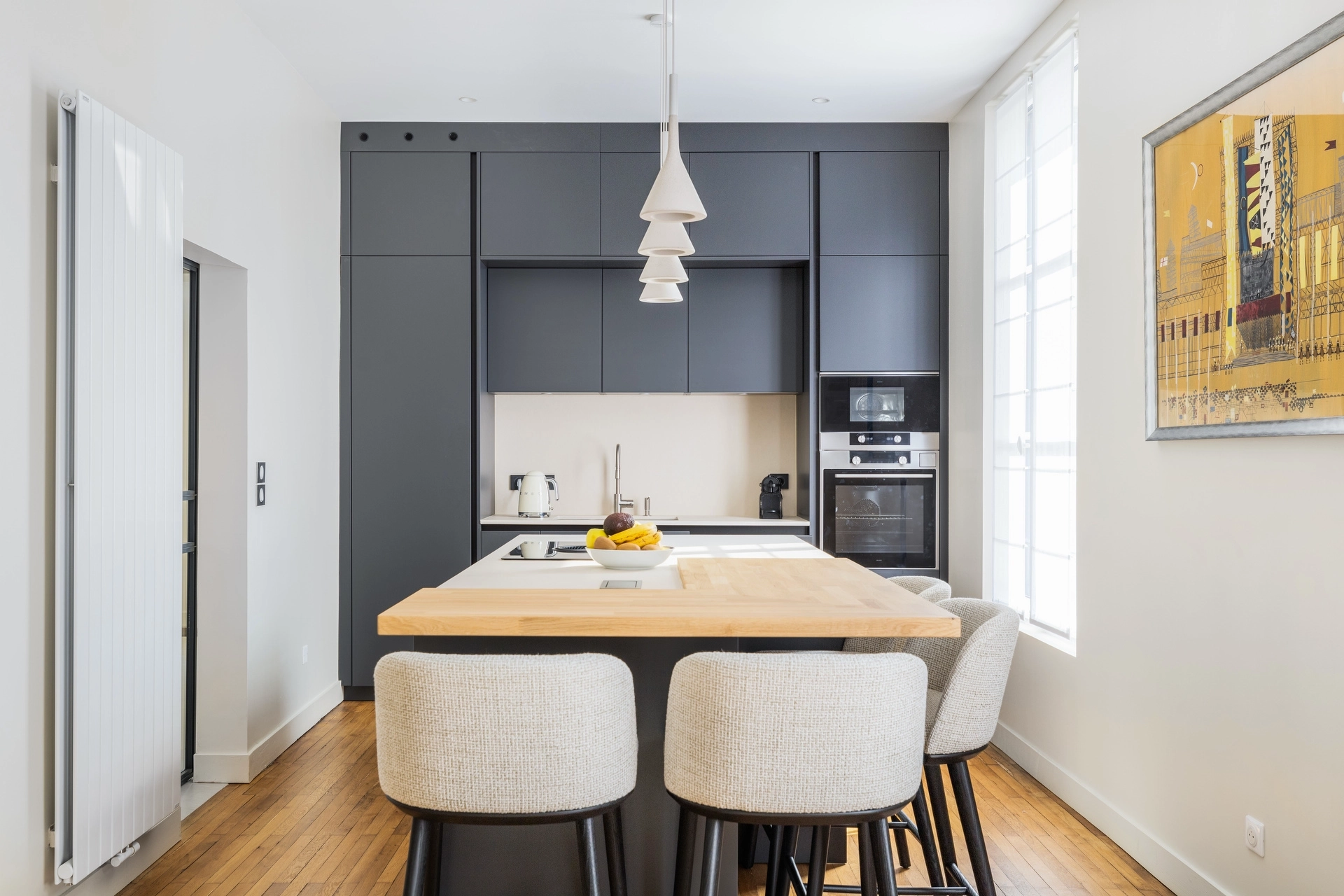
Photographing a high-end kitchen requires a precise approach, capable of revealing both the aesthetics of the location and its functional dimension. It is one of the most demanding rooms to capture: premium materials, architectural lines, technical zones, circulation… Everything must be perfectly readable.
In my work as an interior and architecture photographer, I always seek this essential balance between design and usage.
Understanding the Design: Materials, Lines, and Visual Harmony
When I photograph a contemporary kitchen, I first analyze its organization and structure. Architectural lines play an essential role: they reveal the logic of the project, whether it is a central island, a sleek linear layout, or a symmetrical composition designed by an interior architect.
High-end materials demand great precision:
- Marble or quartz and their veining.
- Noble wood and natural textures.
- Stainless steel and technical surfaces.
- High-gloss lacquers.
- Stone or glass.
Every material reacts differently to light. I primarily use natural light to reveal textures without amplifying reflections. My goal is to faithfully translate the designer’s choices while respecting chromatic harmonies, volumes, and aesthetic intentions.
For projects strongly oriented toward decoration, I often refer my clients to my dedicated page for residential real estate and interior design, which perfectly illustrates this type of approach.
Showing Functionality: What End Clients Want to Understand
A high-end kitchen must be beautiful, but also understandable in its usage. I particularly strive to highlight:
- Circulation between the preparation, cooking, and washing zones.
- Ergonomics around the island.
- The readability of storage spaces.
- Overall organization and consistency between the different poles.
When it brings true value, I integrate subtle elements: an ajar door, an open drawer, a slightly staged countertop. The goal is never to simulate artificial use, but to illustrate the logic of the place.
This approach is widely used by premium kitchen designers, interior architects, and developers, notably to enrich their marketing materials. It also complements my real estate photography services for prestige properties.
The Importance of Styling: Sobriety and Subtle Staging
Styling plays a major role in kitchen photography. It must remain minimalist to let the interior architecture breathe. I use only a few carefully chosen elements:
- A cookbook.
- Some fresh fruit or herbs.
- A light floral arrangement.
- A wooden board or a few understated accessories.
These touches bring life without diverting attention from the design. I ensure that every object is consistent with the project’s mood: minimalist, contemporary, warm, or premium. This step ties into my thoughts developed in the article on the importance of styling in photography.
My Technical Method for Precise and Faithful Images
To guarantee a professional result, I rely on a rigorous methodology:
- Precise correction of optical distortions.
- Flawless horizontal and vertical alignments.
- Mastered management of reflections on glossy materials.
- Choosing the right time based on the room’s orientation.
- Building a complete series: wide shots, intermediate views, and details.
These images allow my clients (architects, kitchen designers, or agencies) to have bright, elegant visuals tailored to all their communication materials.
Conclusion
Photographing a high-end kitchen requires a keen understanding of design and constant attention to functionality. My approach is based on a balance between technical precision, discreet styling, and mastery of light. I thus obtain aesthetic images, faithful to the project, and genuinely useful for professionals in interior design.
Are you a kitchen designer, architect, or decorator? Contact me to beautifully showcase your high-end projects.