
In the collective imagination, fed by the immediacy of smartphones and social networks, a “real” photo would be a raw image, captured on the fly and delivered unedited. However, there is a fundamental misunderstanding about the very nature of professional photography.
Ansel Adams, the legendary landscape photographer, compared the negative file to a musical score, and the print (the development) to its interpretation by the orchestra. In the digital age, this analogy has never been truer. The raw file (RAW) that comes out of my camera is a raw material: it is often flat, grey, and lacks contrast. For an architecture image to become a faithful reflection of the reality perceived on site, it must imperatively go through a crucial and time-consuming step: post-production.
But beware, it is not about disguising reality. The paradox of my profession is this: the more an image seems natural, fluid, and obvious to your eyes, the more hours of work it required to achieve that simplicity.
The Biological Gap: The Injustice Between the Eye and the Sensor
The first mission of post-production is to bridge a technological deficit. As sophisticated as they may be, our camera sensors are far less efficient than the human eye coupled with the brain.
When you visit a real estate property or a public building, your iris adapts in real time. If you look at a dark corner under some stairs, your pupil dilates to see the details. If you look up at a sun-drenched window, it retracts instantly to perceive the blue sky. Your brain fuses this information to create a continuous mental image that is perfectly exposed everywhere.
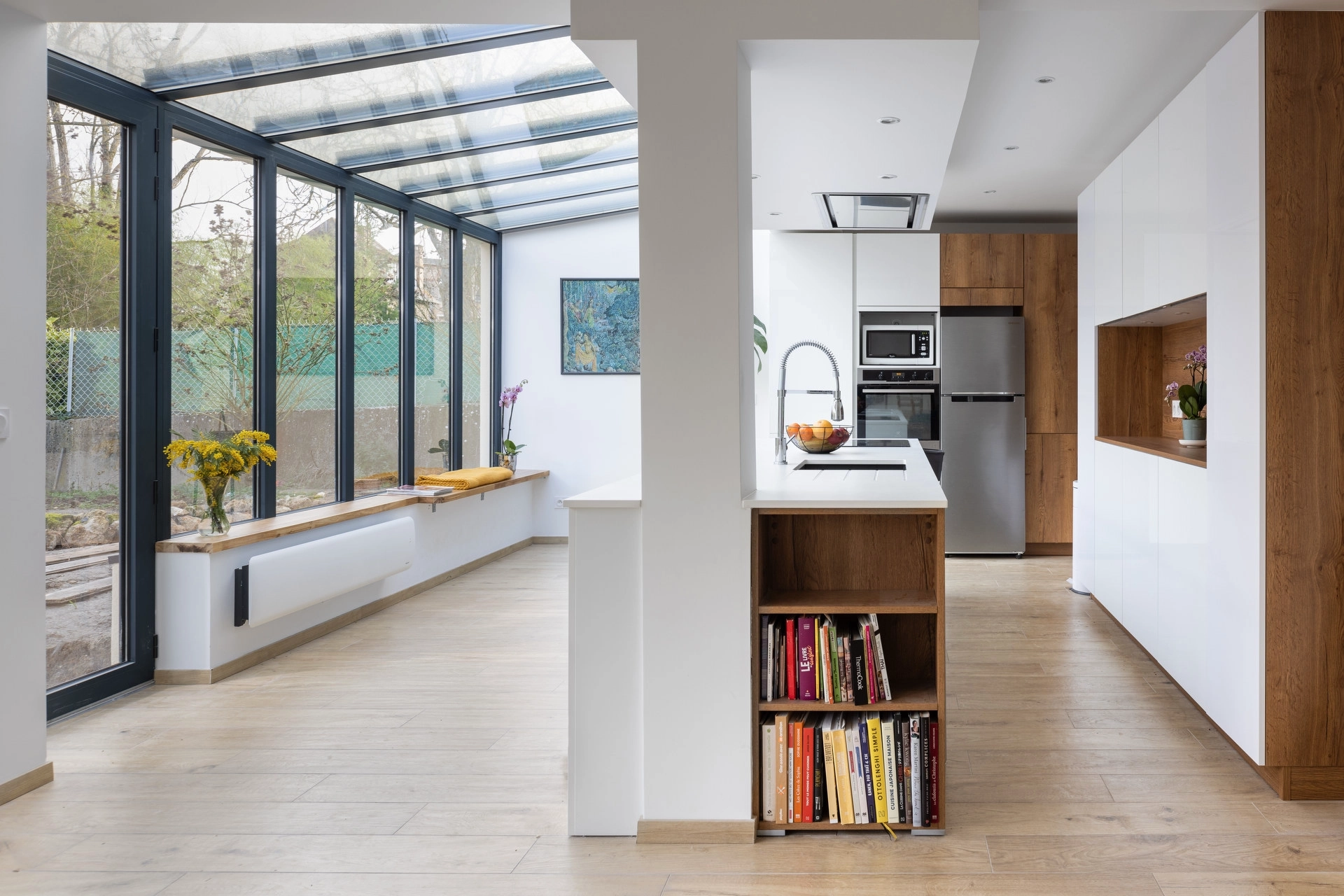
The camera, however, is frozen. It must make a drastic choice: either it exposes for the interior (and the windows become blinding white rectangles, called “blown out”), or it exposes for the outside view (and the interior becomes a black silhouette). My post-production work consists of using the “bracketing” technique (multiple exposures) to manually merge these different exposures. I recreate computationally what your brain does biologically: an image where you feel both the softness of the interior and the presence of the external environment.
The Science of Color: Recovering the Memory of the Place
The second major challenge is color grading. Here again, our brain plays tricks on us by performing a permanent automatic “white balance.” A sheet of white paper placed under a yellow lightbulb will always appear white to us, because our brain corrects the information.
The camera sensor, however, is a cold, objective measuring instrument. It records the actual hue. In a complex indoor scene, as I discuss in my article on retail lighting, we are often faced with “chromatic chaos”:
- Cold blue light entering through the north window.
- Warm orange light from wall sconces.
- Sometimes even a green tint cast by the garden lawn onto the white ceiling.
Without intervention, the final photo would be an unsightly mixture of these hues. White walls would look dirty, wood would lose its natural warmth, and upholstery fabrics would be distorted (a nightmare for interior designers). Digital development is a surgical operation that allows me to isolate each zone to neutralize these color casts. The goal is to ensure that the “Peacock Blue” you chose for that wall is rendered with absolute fidelity, regardless of the time of day or the artificial lighting.
Geometry and Purity: Calming the Reading
Architecture photography is a discipline of rigor. Beyond light and color, post-production is the moment when geometric order is restored. Wide-angle lenses, although necessary to encompass the space, inevitably introduce slight optical distortions or converging perspectives.
However, a building is built straight. A column is vertical, the horizon is horizontal. During image processing, I ensure that all vertical lines are strictly parallel to the edges of the frame. This straightening of perspectives, often invisible to the layman, is what gives the image its “professional,” stable, and soothing character. It is the difference between a photo that makes you dizzy and a photo that grounds the architecture.
The Ethics of Retouching: Cleaning Without Lying
Finally comes the delicate question of retouching distracting elements. Where does cleaning stop and lying begin? My guideline is clear and ethical.
I distinguish the “temporary” from the “permanent.” Although preparation before the shoot is crucial, it is legitimate to erase in post-production what is not meant to stay: a tripod reflection in a mirror, an electrical cable trailing on the floor, an unsightly wall socket, or a construction site sign. This is what I call “visual polishing.” It directs the gaze to the essentials: volume, material, and space.
On the other hand, I never modify the structural characteristics of the property. I don’t erase a load-bearing pillar, I don’t “repair” a crack in the concrete (unless explicitly requested for a simulation), and I don’t change the view out the window. Architecture photography must remain a reliable document.
Conclusion
Post-production is not “cheating” or an artifice designed to save a bad photo. It is the second half of the creative process, the one that requires as much time, if not more, than the shooting itself. It is thanks to this behind-the-scenes step that I can deliver bright, faithful, and timeless images.
To see how this approach translates concretely on real projects, I invite you to browse my portfolios.