
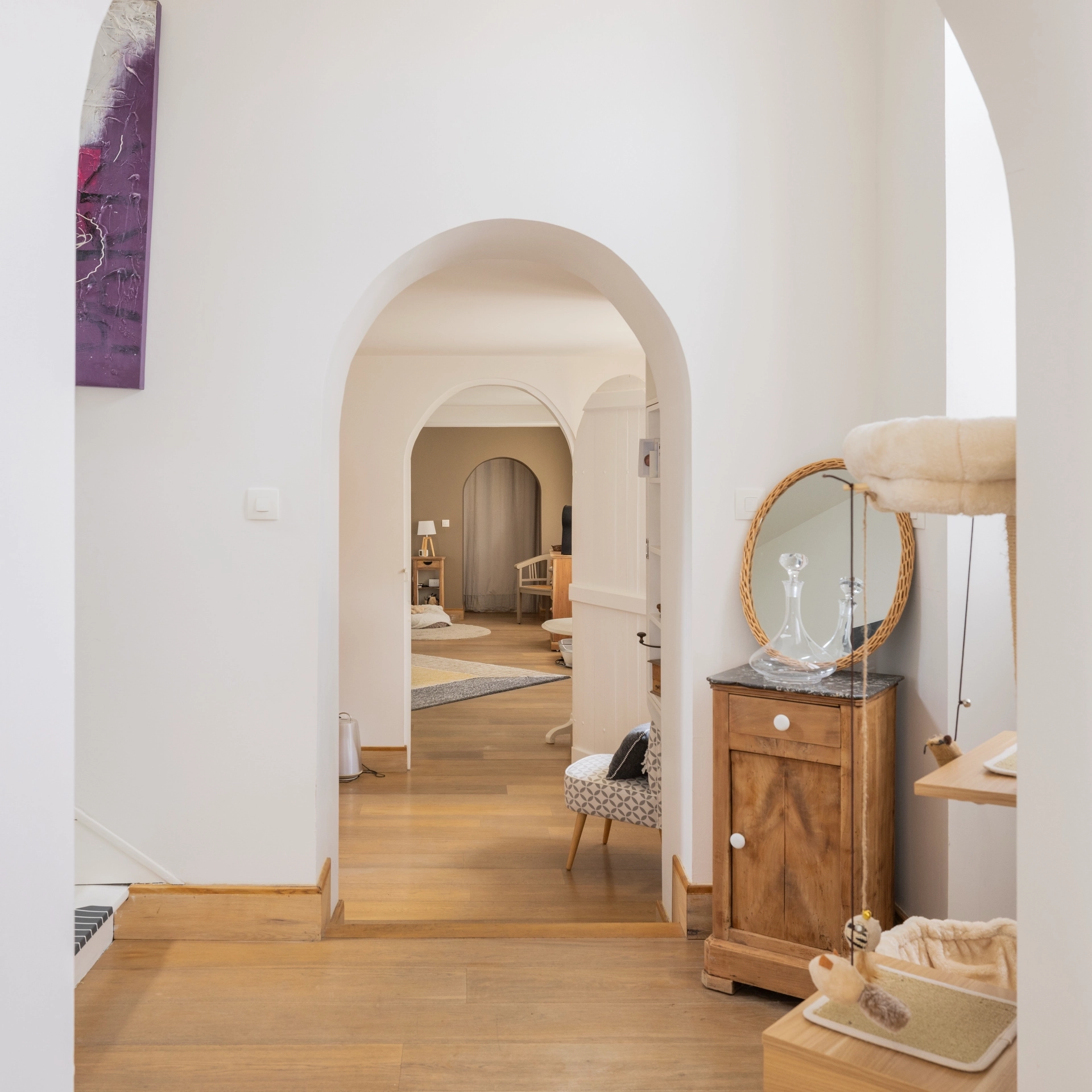
It is a common reflex among amateur sellers and even some professionals: to take a picture of a room, you back up as far as possible into the corner, activate the “0.5x” or “Wide Angle” mode on your smartphone, and shoot. The intention is commendable: you want to “show everything” in a single image. But the result is often counterproductive.
In real estate photography, seeing wide is not enough. Worse, overusing an ultra-wide-angle lens can distort reality and harm the sale. Here is why I favor an approach based on realism.
The “Bowling Alley” Effect and Distortion
Optics is an unforgiving physical science. The wider the angle of view, the more the edges of the image stretch. With an unsuitable lens, a 100 sq ft bedroom can look like a massive loft, but at the cost of grotesque distortion:
- Objects in the foreground appear giant.
- Distant walls look tiny.
- The room resembles an endless hallway.
To avoid this, I use specific lenses (Tilt-Shift) that keep vertical lines perfectly straight and respect true proportions, as I explain in my article on the Tilt-Shift lens.
Trust is Earned Through Realism
What is the risk of a misleading photo? Disappointment. If a buyer travels thinking they will see a 400 sq ft living room (because of the photo) and discovers a 250 sq ft room (the reality), their very first emotion upon entering will be negative. They will feel cheated. The viewing starts poorly, and trust in the agent is broken.
Conversely, a photo with accurate volumes qualifies the visitor. The person who comes to visit knows exactly what to expect: they are coming to confirm a crush, not to measure square footage.
Better Two Good Photos Than One Bad One
Rather than trying to cram the living room, the kitchen, and the entryway into a single distorted, shoehorned image, I prioritize photographic composition. I often shoot two complementary angles. This makes it possible to:
- Show the space from different axes.
- Understand the flow and connection between rooms.
- Maintain a vision close to the human eye, comfortable to look at.
Pro Gear vs. The Smartphone
This is where a large part of a professional photographer’s added value lies. The “Wide Angle” lenses on smartphones are designed for landscapes, not architecture. They curve lines (“fisheye” effect). My professional optics are “rectilinear”: they are designed to see wide while keeping the walls straight and the proportions faithful.
Conclusion
In real estate, the goal is to enhance, not to cheat. Accurate volumes attract serious, qualified buyers. It is this visual honesty that makes the difference between a listing people just scroll past and a listing they actually visit.
Do you want photos that sell without lying? Check out my examples of realistic reportages on my Architecture Photography page.