
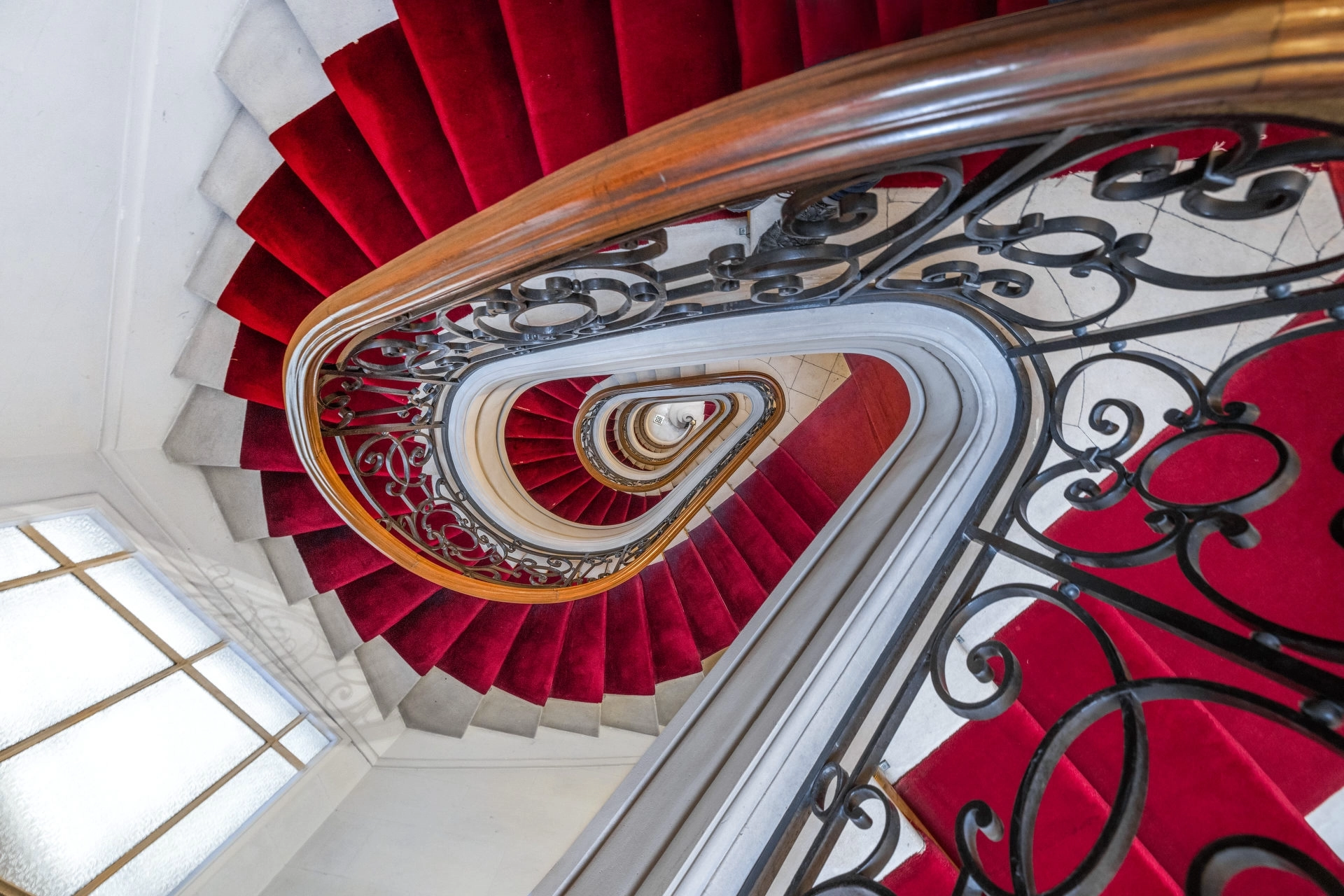
The staircase is often perceived as a mere functional element. In reality, it occupies a central place in many architectural projects. A true backbone of a building, it structures circulation flows, organizes volumes, and often embodies the architect’s aesthetic intention. In architecture photography, the staircase deserves special attention: properly photographed, it becomes a centerpiece of the visual narrative.
The Staircase as a Sculptural Element
In many contemporary projects or renovated heritage buildings, the staircase is designed as an architectural object in its own right. Suspended flights, minimalist railings, interplay of materials, or curved lines: it sometimes resembles a sculpture integrated into the space.
Photographing a staircase therefore implies a fine reading of lines, proportions, and vanishing points. The choice of viewpoint is decisive. A frontal shot can emphasize symmetry, while an oblique angle reveals the dynamics of the volume, following my approach described in The rigor of symmetry and the frontal viewpoint.
Light: Revealing Structure and Material
The staircase is often a natural light catcher. Skylights, vertical bays, or side openings frequently accompany this circulation element. Photography must take advantage of this light to reveal materials, textures, and depth.
Depending on the building’s orientation, light can radically transform the perception of the staircase throughout the day. Anticipating these variations is an integral part of my job, as I explain in Why a building’s orientation radically changes the photographic approach.
In some contexts, a subtle balance between natural light and artificial lighting helps maintain a realistic reading of the space, without crushing contrasts or betraying the mood of the location.
Showing Use Without Freezing the Space
A staircase is not just a graphic object: it is a space for passage, movement, and transition. In architecture photography, the challenge is to suggest this use without falling into artificial staging.
A discreet human presence, a mastered motion blur, or a composition hinting at circulation reinforces the credibility of the image. This approach echoes my reflection developed in Architecture and photography: what the image must show… and what it must deliberately hide.
The goal is not to literally document usage, but to suggest the life of the building.
Dealing with Technical Constraints
Staircases often combine several photographic difficulties: narrow spaces, varying ceiling heights, steep low angles, and risks of optical distortion. Poor management of these parameters can quickly distort the perception of volumes.
The use of adapted lenses and the controlled correction of perspectives are essential, as I detail in How I anticipate and correct optical distortions in architecture. The goal remains the same: faithfully restoring the architectural intent without visible artifices.
Conclusion
Photographing a staircase is about telling much more than a simple story of circulation. It is about revealing an architectural intention, a relationship with light, and a way of inhabiting space. When approached with rigor and sensitivity, the staircase becomes a strong marker of a project’s identity and an essential visual anchor point in a cohesive architecture series.